Twenty-one retailers put their hats in the ring for the inaugural Smartest Store in the World competition. They represent a who’s who of retail leaders from North America, Europe and Asia, ranging from large operations to tech-forward independents with a handful of stores.
“It was incredible to see the global participation and the willingness these retailers had to share their insights,” said Henry Armour, chairman emeritus and CEO international at NACS. “This competition is a chance to elevate the entire industry—and the retail experience in general—by recognizing and connecting those driving progress.”
The winner, announced at NACS Convenience Summit Europe in Warsaw in June, was Wumart’s Xueqing Road store, located in Beijing, China. The retailer’s “pioneering AI-powered flagship” features innovative uses of artificial intelligence technology.
“In many ways, this was a research project to find out where AI is in retail,” said Dan Munford, CEO of Insight Research and Global Convenience.
Munford pointed to the ideal timing of the competition, capturing retailers as they start to operationalize agentic AI.
George Zheng, NACS Asia Pacific Director, was one of the 12 judges for the competition. He stressed that the submissions were about technology solving problems instead of technology as a shiny object. “I always think of their ROI,” he said. “It’s not about how advanced this kind of technology looks. I’m more interested in those people using less investment but really resolving some problems.”
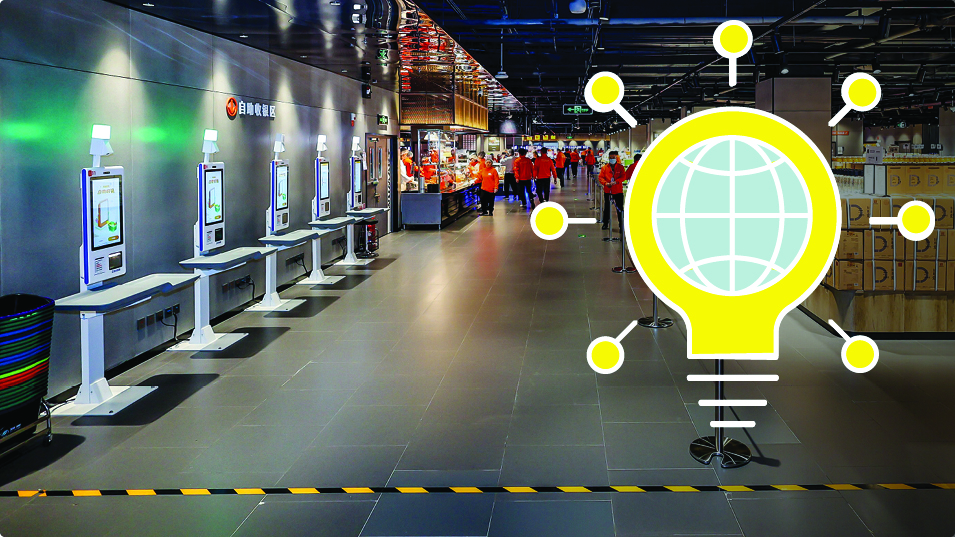
Zheng pointed to the submission from 7-Eleven South China. The retailer introduced a new self-checkout system for fresh food that uses technology developed by Dmall. It removed a series of small frictions that were unique to the retailer’s foodservice offer, which consists of an extensive assortment of a la carte items that were time consuming to ring up at the cash register. Now, customers can go straight to the foodservice offer, point to what they want, get a receipt with a QR code and pay at the self-checkout station. This “one simple solution,” Zheng said, built to solve a particular operational problem, has saved the retailer more than a million labor hours since it was implemented.
Martin Baille, a growth and AI expert who previously spearheaded a Tata and Tesco joint venture in India, was also a judge. Like Zheng, he emphasized that the submissions aren’t “tech for tech’s sake.” He cited the rising cost of doing business as a driver for innovation.
“AI is naturally being spoken about a lot. … What it does is bring speed, accuracy and therefore agility,” said Baille. “But for me, it’s about empowering the employees, the human, and ultimately not replacing them.” Freeing frontline staff to add value to the customer journey is “the biggest win of all.”
Wumart | Xuequing Road, Beijing
“Wumart is an AI-first business,” Munford explained when he announced the winner of the competition. “This is a new kind of retailer. AI agents are running the store.”
An AI merchandise agent covers the end-to-end product lifecycle. “It drives a perfect closed loop of key actions, from market insights and smart assortment to auto-replenishment, dynamic pricing and slow-seller elimination,” according to Wumart.
An AI store agent acts as the store’s intelligent central nervous system, providing “24/7 real-time monitoring of operational status, proactively analyzing data and directly intervening in execution workflows.”
The winning location in Beijing is the Wumart AI flagship, but the technology has been rolled out to 40 Wumart locations.
For Gray Taylor, who is a senior advisor to NACS and was one of the judges, what stood out was how the Wumart location flips expectations around AI. “Everybody uses AI to go out to the people with messaging. But often you don’t have enough data points, you don’t have enough participation.” Wumart is focused on in-store operations and customer behavior in the store. “It’s basically collecting every bit of data that it can and feeding it into AI in real time. Then real-time decisioning comes out of it.”
One way Wumart uses AI to transform operations is through dynamic clearance pricing. The system recognizes the need for clearance pricing, determines the optimal discount and the right time to lower prices, and pushes the new pricing and promotional language to digital shelf labels (DSLs). The human role can be simplified to one-click approval.
Troy Du is the global branding and marketing lead for Dmall, Wumart’s technology partner in the project. Wumart and Dmall were both founded by Dr. Zhang Wenzhong and operate closely together.
According to Du, Wumart is “pioneering AI in one of the most competitive retail markets: mainland China. The massive competition in China really helps us to improve AI, because we just cannot make AI a demo or a proof of concept. We must make it practice real operations.” He continued: “We don’t just see AI as a tool to replace one specific function. We redesigned the whole workflow around AI. We changed almost everything.”
“In the traditional way, merchandising was divided into sourcing, assortment, pricing, replenishment and clearance,” said Du. When Wumart first piloted its AI project, it continued to think of merchandising as having separate functions. “We had separate, isolated AI replenishment, for example, and isolated AI clearance dynamic pricing.”
While efficiency did improve, “it basically was not as good as we expected,” Du said. “Now Wumart is using a merchandising agent to control that whole part of the business. We totally changed the flow. … We changed the entire workflow around AI.” Du emphasized that this includes every job function and how employees are trained. AI isn’t bolted on to the way things have always been done. It’s the core of the store.
“AI is not perfect,” said Du. “From the very first day, Wumart knew that there would be a lot of mistakes.” The retailer built feedback loops so that its stores would “evolve and improve day to day.”
Marcus Spurrell is the CEO of Dmall. Speaking about retail in general, he said that “the sensing part”—computer vision or other ways of gathering data—”is kind of happening in real time, but it’s just data that gets thrown up and historically is in dashboards and reports.
And the decisioning component and the execution component, they drop right back down to human speed. They’re not running at real time at all, right?”
“Now that we see more and more broader application of digital technologies in the sensing systems themselves, this layering in of AI on top of it to do the decision-making … I think is something that we’re going to see rapid expansion of across all of the retail processes,” Spurrell said.
FairPrice Finest | Punggol Coast Mall, Singapore
“FairPrice in Singapore was one of the top contenders because it’s a connected ecosystem. It’s not just one thing. It’s an integrated intelligence system,” said Gray, managing director at Accenture.
The Grocer Genie “superapp” consolidates task management, communication and store operations for frontline workers. Operationally, AI vision, AI agents and digital shelf labels combine to create more efficient real-time operations.
Customers benefit from AI-powered shopping assistants and smart carts. Customers using the smart carts have baskets three times larger than customers who use traditional checkout. In its submission, FairPrice noted that a smart cart “identifies the customer, processes items in real-time and integrates with our payment and loyalty systems.” This includes applying any government benefit, such as discounts for seniors.
Kavanagh’s | Belsize Park, London, England
“Kavanagh’s in London was able to prove that innovation isn’t just for the big players,” said Accenture’s Gray. The grocer combines Bluetooth shelf rails, AI vision and an analytics engine to monitor pricing, availability and shelf execution continuously.
In its submission, Kavanagh’s noted that “like many physical retailers, the store generates vast amounts of data from transactions and stock levels to pricing and promotions, yet historically much of this data has been fragmented across disconnected systems. The challenge is not a lack of data, but a lack of real-time visibility and actionable insight.”
In partnership with Vusion, Kavanagh’s transformed its store into a fully connected, data-driven environment. The goal is physical retail that operates with the intelligence and responsiveness of a digital ecosystem.
Pricing updates are executed instantly, competitor pricing is tracked daily and shelves are continuously monitored. The results? Waste cut by more than 50%, 100% pricing compliance, and 98% on-shelf availability.