After a morning packed with data, benchmarks and hard truths about convenience industry financial and operational performance in 2025, Chris Rapanick’s final slide during his NACS State of the Industry Summit presentation brought the conversation to a simple yet complex question: What now?
His suggestions were not spaghetti on the wall. The path forward comes down to discipline: get to know the story your P&L statement is telling you, focus on the fundamentals that drive profitability and act on the metrics that matter.
Rapanick’s message was clear: Hope is not a strategy—you have to have a plan. There are five key areas retailers can focus on.
1. Track Your Breakeven Pool Margin
Breakeven pool margin represents the fuel margin required to cover total store operating expenses after inside gross profit. It’s a direct measure of how dependent a store is on fuel profits to keep the lights on.
“This is the best measure of fuel dependency. If you haven’t been monitoring this, now is the time,” said Rapanick, managing director of NACS research.
Operating a convenience store has become significantly more expensive in the past five years, with total expenses up 23.3% since 2021. Rapanick said that knowing how much margin is needed to cover operating costs allows retailers to determine how exposed they are when fuel margins tighten, as well as how much pressure is placed on growing inside sales.
In 2025, fuel margins averaged over 40 cents per gallon, which helped offset weaker inside GP growth. However, rising expenses mean those margins are increasingly used to cover costs, leaving less room for error if fuel prices rise or volatility increases.
“NACS has been beating the drum for years that retailers should work to pay an entire site’s bills by using inside gross profits,” he said, adding that the business today requires higher fuel margins just to break even, let alone make a profit.
As we get past the halfway point in 2026, geopolitical issues are putting pressure on oil supply, and subsequently gas prices, right as the peak summer months hit.
“This is why we care about breakeven pool margin,” said Rapanick. “With the current war in the Middle East and other geopolitical issues, supply will likely get tighter, crude prices will rise and that leaves retailers in a tough situation,” he said, adding, that retailers can either hold margins against higher prices at the pump and breakeven, “or they can let some margin go and keep prices as low as possible and risk short-term profitability.”
2. Make Inside Transaction Counts the Core Mission
One area where the call to action was loudest was growing inside transactions.
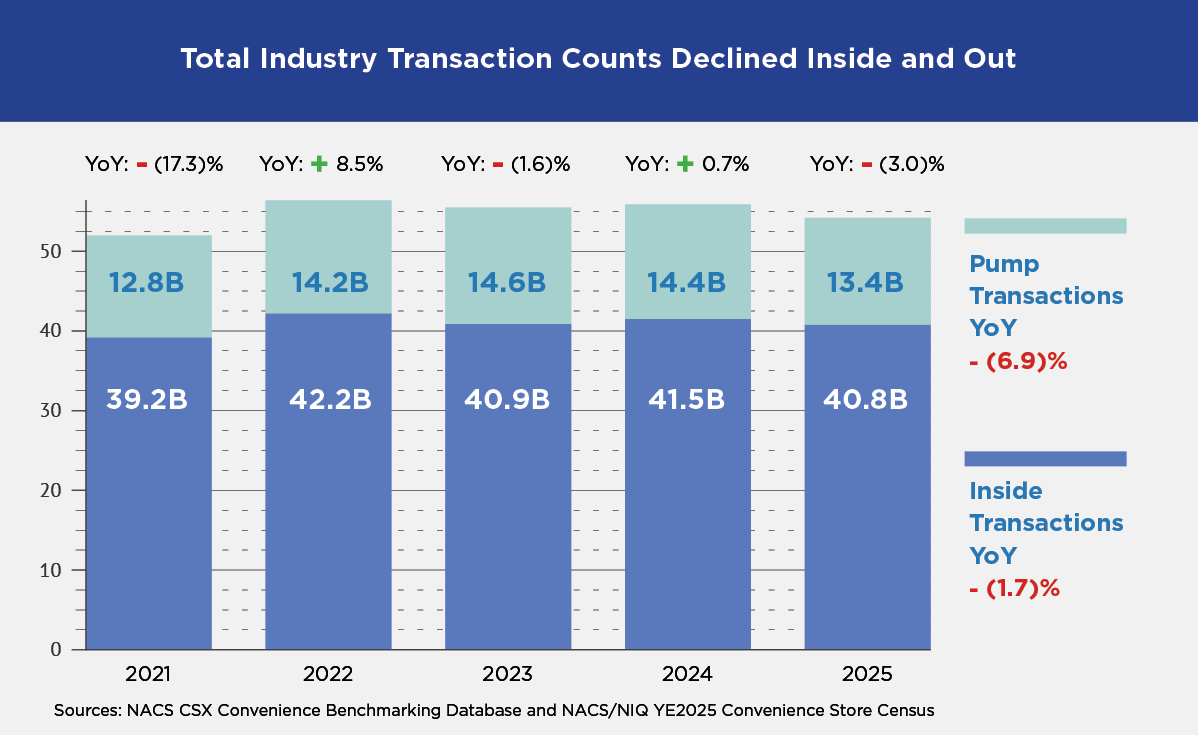
Total transaction counts across the convenience industry declined in 2025, falling 3.0% as both in-store and forecourt transactions decreased. After a brief uptick in 2024, inside transactions slipped back below 2023 levels, while fuel transactions fell to their lowest point since 2021.
The transaction counts raise a critical question for retailers: How do industry trends compare to what’s happening at your own stores?
Every initiative—from foodservice programs to product marketing, loyalty strategies, promotions and store redesigns—will succeed or fail on a retailer’s ability to get customers from the forecourt to inside the store.
Although time will tell if fuel margins hold or pricing conditions improve, sustainable growth will come from increasing customer counts. “If you’re not actively strategizing around traffic, you’re leaving your future to chance,” said Rapanick.
3. Grow Basket Value—One Item at a Time
An effective way to build basket value doesn’t come from sweeping changes or expensive remodels—it’s adding one item to every basket.
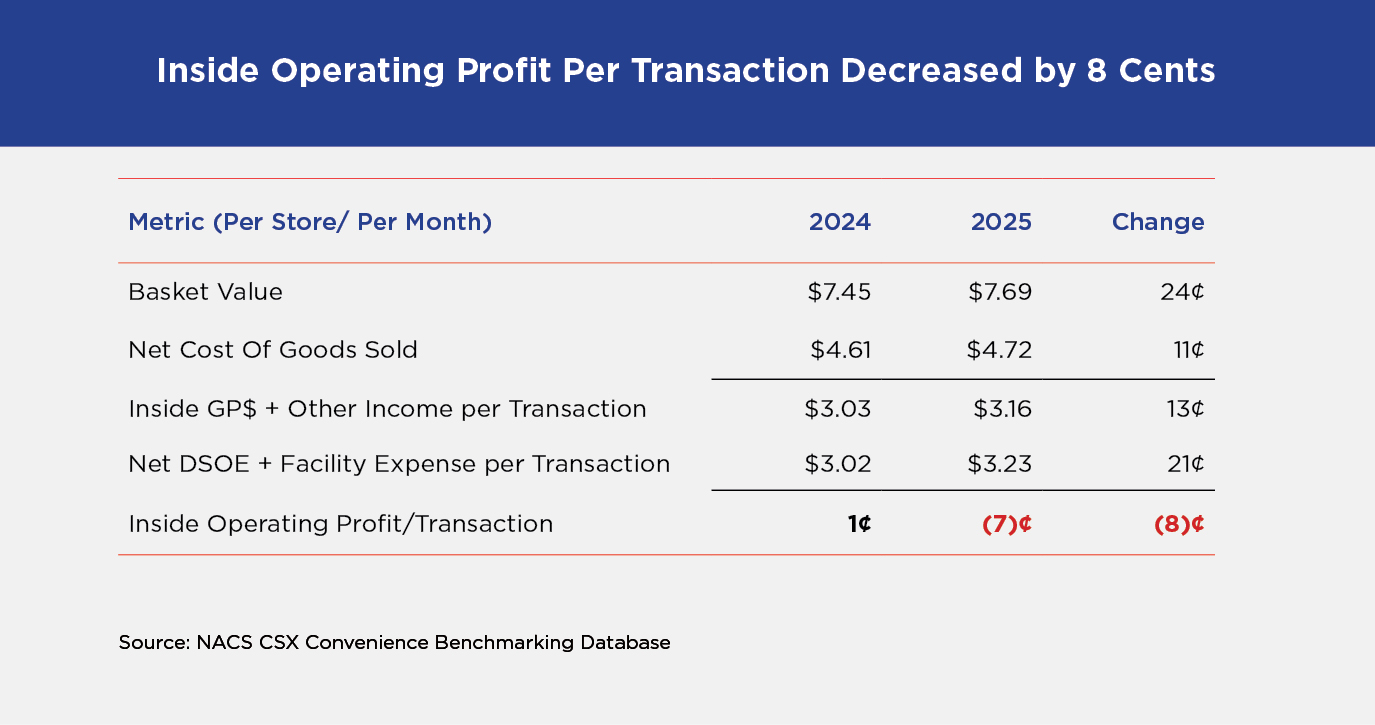
Rapanick noted that 2025 delivered a 24-cent year-over-year increase in basket value, which is good news on its own. However, the year-over-year increases in cost of goods sold and total expenses delivered a tougher result.
“The small increase in inside gross profit didn’t come close to offsetting the growth on direct store operating expenses, which led to an 8-cent decline in basket profitability in 2025 vs 2024,” he said.
Rapanick suggested that as retailers strategize how to increase transaction counts, they do so in tandem with strategizing how to grow basket value.
“Think about your store teams upselling and running effective promotions. Basket profitability is a game of pennies, where adding one item to a basket can turn a loss into profit,” he said.
4. Treat Expense Control as a Strategic Discipline
As the saying goes, you can’t manage what you can’t measure.
“Expense control is paramount. When sales and gross profits are contracting, the best defense is to track expenses and cut meticulously,” said Rapanick.
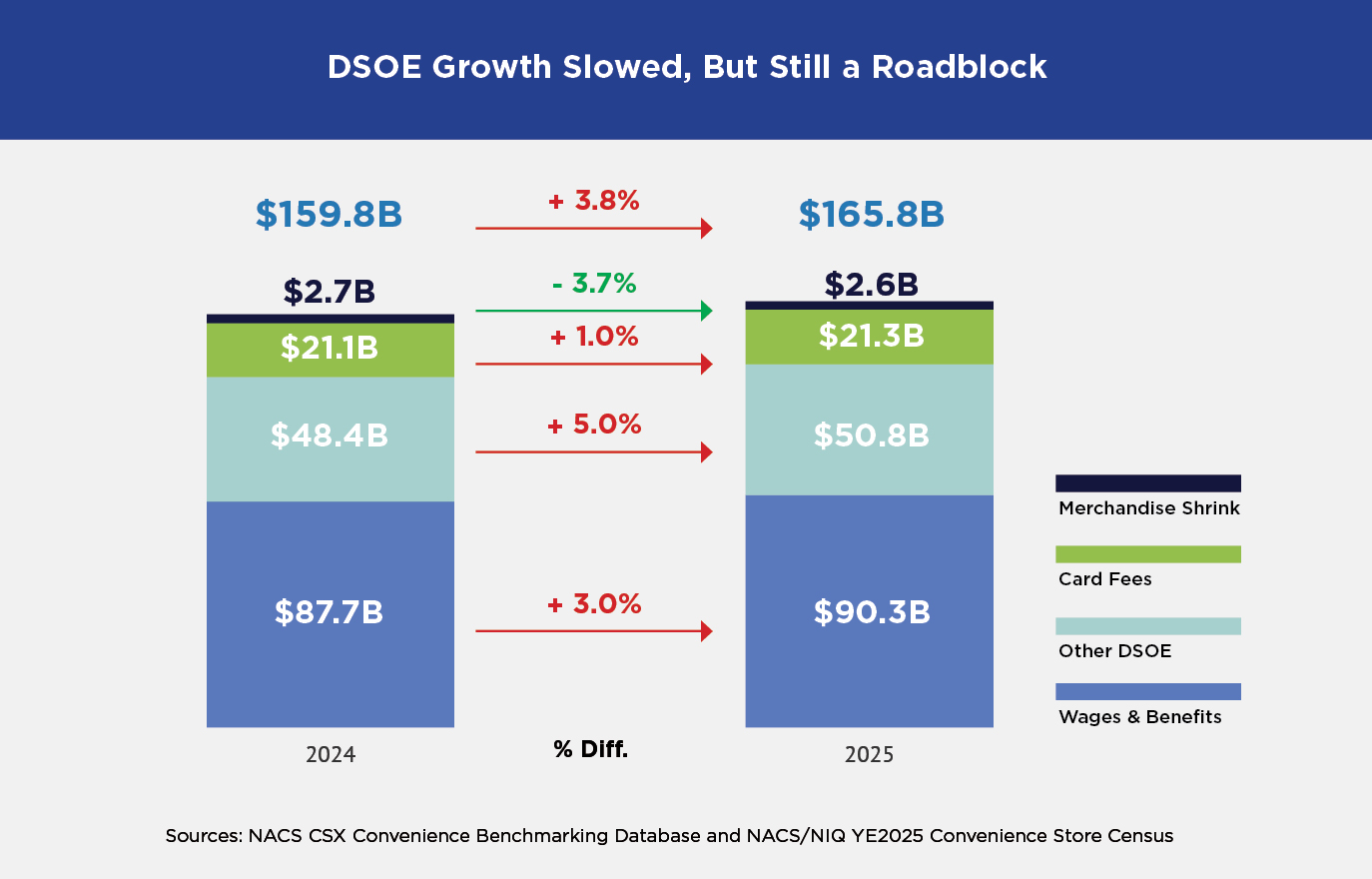
Direct store operating expenses (DSOE) continue to outpace inside gross profit dollar growth. Total DSOE was just under $166 billion in 2025, but the good news is that the rate of growth did slow to 4.2% compared to the 7.1% rate of growth experienced in 2024.
Despite the slower pace, every expense category grew in 2025 except for a slight decline in merchandise shrink, which had trended upward the past few years.
Rapanick noted that card fees were expected to decline as gas prices declined. However, 2025 was the third consecutive year were the average price per gallon declined and card fees continued to grow.
“For this to happen, it comes down to the volume of dollars paid with credit cards,” said Rapanick. In 2025, 82% of the $817 billion in industry sales was transacted on a card.
In 2025, the convenience industry paid $21.3 billion in credit card swipe fees including $4.6 billion in fees on taxes collected, noted Rapanick. “If you aren’t asking your Members of Congress to vote yes on the Credit Card Competition Act, we strongly suggest that you start,” he advised.
5. Reduce Turnover to Unlock Productivity
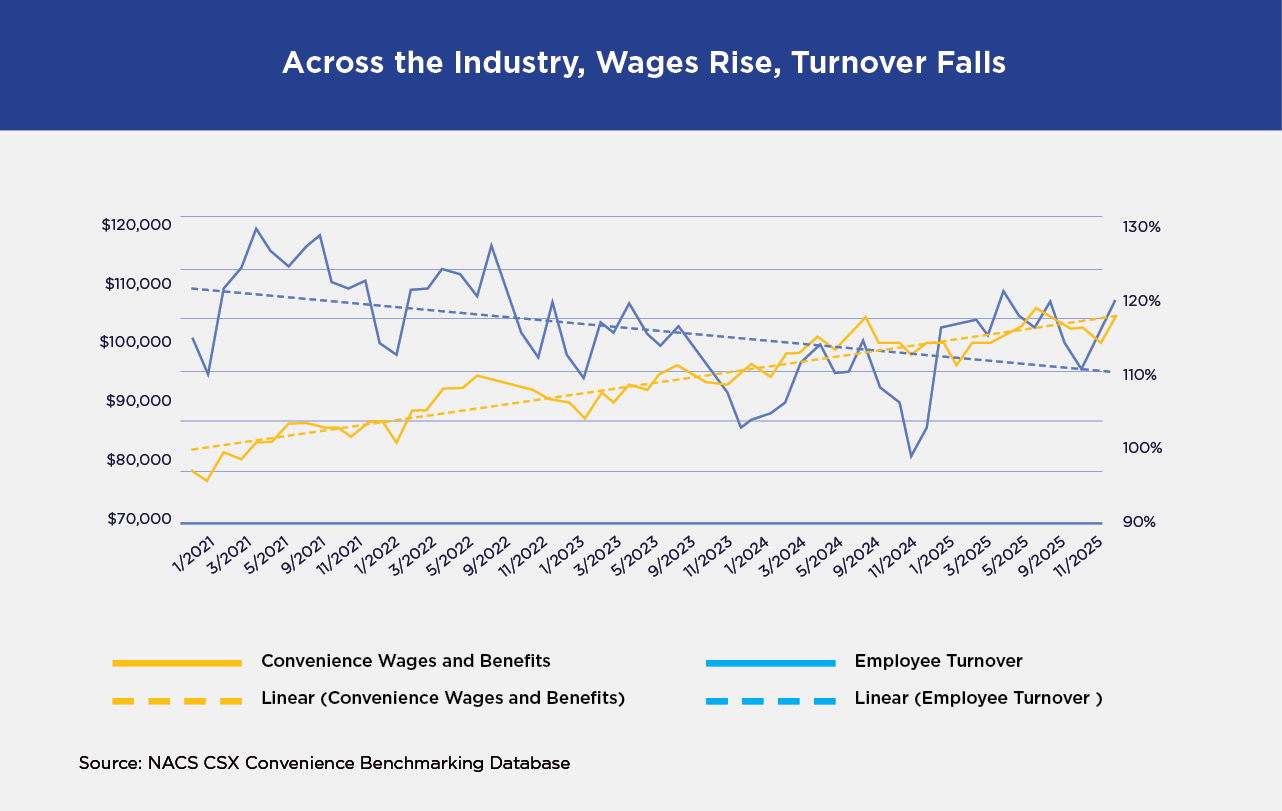
Reducing turnover is a perennial issue for the convenience industry. Over the past five years, wages and benefits expenses increased from about $80,000 per store, per month to about $104,000. During that timeframe, employee turnover had been on a general path of decline: average turnover spiked in 2021 at about 130% and dropped to as low as 99% in late 2024.
“This is likely not causal, but it does give some assurance that increases in wages appear to be money well-spent,” said Rapanick.
Turnover for both store managers and store associates improved in 2025, although manager turnover spiked in Q4 of 2025.
Although employee turnover for the industry is still over 100%, “the industry gained a lot of momentum in 2025,” said Rapanick, adding that low turnover translates to higher productivity, improves employee morale, promotes shopper loyalty and reduces operating expenses.
Measure What Matters and Take Action
The challenges and opportunities shared by Rapanick were straightforward: Identify the metrics that are most important to your business and create a strategy to address them.
“If you aren’t measuring your business in these five ways, I suggest you look at ways you can rethink and lean in,” said Rapanick. “We all hope that fuel margins hold and baskets grow, but we need to step up and take action on customer transaction counts inside the store and on the forecourt and find ways to reduce expenses. These things will all lead to lower breakeven pool margin and, ultimately, a more profitable business for you and your companies.”