This article is brought to you by SNK Petroleum Wholesalers.
For those who aren’t afraid to take on a challenge, aging fuel retail sites present rich opportunities. Bringing an underperforming site back to life requires dedication, a smart plan, and an investment of time and resources—but it doesn’t always mean knocking things down and starting from scratch. “When you’ve done a lot of turnarounds, you understand that it’s the little details that matter,” said Messim Kirmani, COO of SNK Petroleum Wholesalers.
With a network of more than 250 stations across nine states in the Northeast and the Midwest, SNK Petroleum Wholesalers has grown in part by refurbishing old sites and modernizing the customer experience. Rather than tearing down existing locations, the company focuses on strategic improvements that elevate both operations and customer experience.
“Experience means everything,” said Messim Kirmani. Investing in features like good lighting, a pothole-free parking lot, clean stores and updated bathrooms can make all the difference—“little details that you wouldn’t imagine make a huge difference really do,” he said.
The Future is Bright
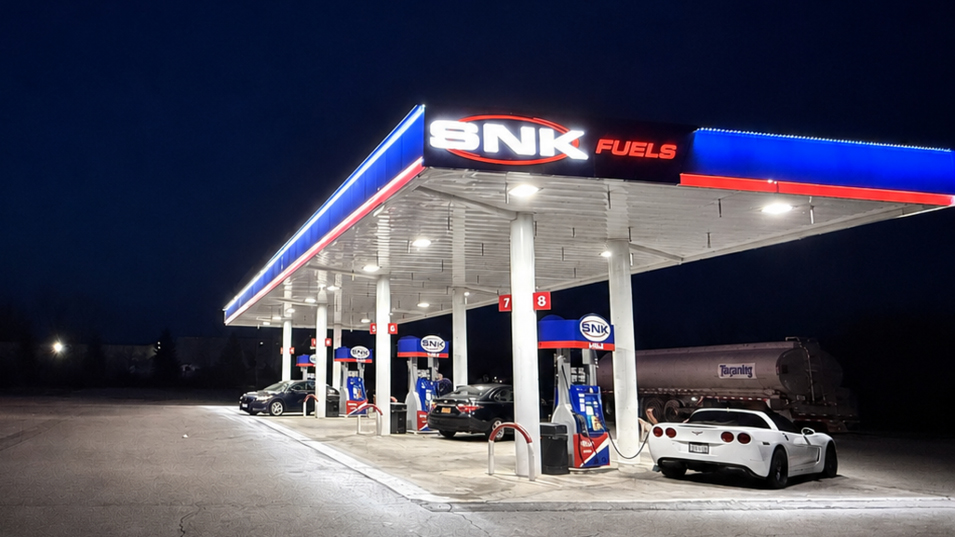
SNK’s approach to redevelopment often includes new fuel canopies, fresh paving, renovated interiors and, critically, good lighting. Investing in a canopy with LED lighting can make a site feel safer and more comfortable, according to SNK.
It can also contribute to making an old site feel completely refreshed. “I want customers who remember the old location to come back and be completely surprised by what it’s become,” said Messim Kirmani.
SNK helps its partner retailers by providing a data-driven business model and coaching services to improve station performance and unlock new opportunities. The company works with construction teams to identify what elements of a site need improvement and get those projects completed quickly.
“We coach them, we guide them,” said Ali Kirmani, who co-owns the company with wife Fatima Kirmani. “This is not a one-time thing. We turn things station around and we have a high success rate.”
The goal of a site renovation should be to wow returning customers who were familiar with what it used to look like. “I want them to be completely impressed by how it’s changed,” said Messim Kirmani. A strong investment in new fixtures that make the forecourt and the store comfortable and approachable can go a long way toward drawing in new and old customers alike. “People may not always enjoy filling up their tanks, but at least we can make it the best experience that we can make possible,” he said.
Technology Drives Loyalty
Investing in the latest technology—new pumps with touch screens, video players, and easy-to-use card readers—can go a long way toward improving the customer experience.
Customers want to have a whole experience in addition to a good deal, reports Messim Kirmani. “You could have the cheapest gas in town, but if the experience isn’t there, customers won’t come back,” he said.
The company is investing in technology that drives customer engagement. In many of its site renovations, SNK installs modern fuel dispensers with integrated digital media systems. During the couple of minutes that customers are filling up their tank, they can see what deals are available inside the store, and any promotions that might be going on. “It’s very user-friendly—you can check the weather, you can check the map, you can see traffic updates,” he said.
“The future of fuel retail will increasingly revolve around direct digital engagement with consumers,” said Messim Kirmani. SNK is preparing to launch a proprietary loyalty rewards app, a debit payment system and integrated fuel savings and rewards programs.
A 2026 consumer survey by NACS found that among c-store loyalty program members, more than half (53%) said they were willing to shop at a c-store because of its loyalty program. There’s a lot of opportunity to grow those programs—the same survey found that only 16% of consumers reported sales, deals or discounts “very often” when shopping at convenience stores.
“The most important thing is to build not just a one-time customer, but a loyal customer base that wants to come back,” said Messim Kirmani.
More than a Store
The NACS consumer survey found that refueling is the main reason for most consumers’ trip to a convenience store, but nearly two in three consumers (62%) say they also went inside the last time they bought gas. “The gas station is not a gas station anymore,” said Ali Kirmani, “it’s whatever you need it to be.”
Inside the store, SNK works with retailers to tailor product offerings to the surrounding communities by analyzing consumer demographics, local competition, traffic patterns and purchasing behavior. That data guides recommendations on where to invest more resources—an area with no grocery store nearby might be able to drive sales by providing produce or other staple food items; a chicken program is more likely to succeed if the site is surrounded by burger restaurants.
“Every area has a different set of demands, and it’s crucial that you cater to all types of customers,” said Messim Kirmani. That careful, location-specific investment helps improve the community around a site. “When we improve a site, we improve the neighborhood around it too,” Ali Kirmani said. “That responsibility matters to us.”
SNK is a family-run business, and it sees its partners as extensions of the family. That shared investment in success is part of what has built their success. “We started in 1996 working in a gas station, but we had a big dream,” said Ali Kirmani.
Today the company supplies millions of gallons of fuel per year and continues to expand its locations across the Northeast and Midwest. With investments in retail operations, transportation and technology, SNK aims to surpass 300 retail locations and reach over 500 million gallons in annual fuel volume by 2029.