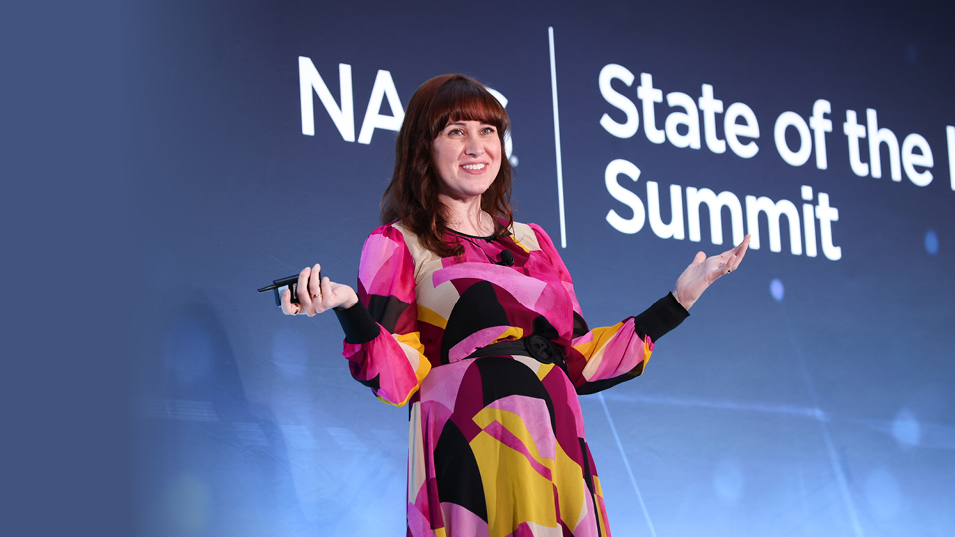
Regardless of the industry you’re in, we’re all ultimately in the experience business,” said Brittany Hodak, award-winning entrepreneur, customer experience expert and author.
Eighty percent of consumers say that the experience a company provides matters just as much as its products or services. “And guess what? They’re not just comparing you with your direct competitors. They’re comparing you with the best experiences they’ve had anywhere,” she said. The ease of DoorDash, the speed and simplicity of Amazon or the personalization of Netflix are what consumers expect now—it’s the new normal.
As competition heats up in retail—from competitors within the channel, adjacent sectors and from other forces such as economic headwinds or consumer sentiment around household budgets—capturing market share and cultivating customer loyalty is becoming more important than ever.
In the convenience business, retailers can accomplish that by creating superfans, said Hodak. Hodak’s definition of a superfan is “a customer or stakeholder who is so delighted by their experience that they become an enthusiastic advocate.” In other words, customers who create more customers.
Hodak said there is one threat that can undermine even the most profitable businesses. “That threat is apathy. It’s customers who just don’t care enough to choose you. They see you as simply a commodity provider and not a category of one,” she said. “So in a world where apathy is everywhere, being good enough isn’t good enough. You’ve got to be super.”
Creating super experiences for your customers is what kills apathy and will help you differentiate your business.
“Superfans are created at the intersection between your story and the customer’s story—when those two overlap, that is where apathy dies. That is where you have the chance to prove to them that you are unlike anybody else, that you care about them and their experience and that you’re going to do everything in your power to make them a superfan of your brand.”
“Advocacy is one of the only forces in the world more powerful than apathy. When your customers are advocates, when they’re telling the world why they love you, that is more effective than just about anything you can do on your own because it lends credibility,” said Hodak.
So how do you create superfans? With the SUPER Model.
Customers can have one of three types of interactions with your store—positive, negative or neutral. “The key to creating superfans is to find those neutral touch points and elevate them to positive ones.”
Hodak has a five-step formula for creating superfans.
Story
Storytelling is the most underrated skill in business, Hodak said, quoting Gary Vaynerchuk. A story is what gives you the chance to connect with your customers. “Our brains are hardwired for connection and to react to stories. So everything you are doing in your business, every touch point, is an opportunity to bring your brand story to life. What are those touch points for you that show why you deserve superfans? Everything communicates.”
Understand Your Customer
Connecting with your customers starts with understanding them. According to a recent study of 13,000 people by Salesforce, 61% of customers said the majority of companies that they deal with treat them like a number.
“When you begin treating your customers as interchangeable numbers, that’s the minute they start seeing you as an interchangeable commodity provider,” she said. “So think about how to train your teams to connect with your customers. To showcase curiosity, empathy or connection while they’re in the store. When we do that, when you connect your story to theirs, it becomes very easy to personalize those moments.”
Personalize
Hodak said there are two types of personalization—high tech and high touch—and you’ve got to have both to have high impact. High tech are the things you can automate, like loyalty programs or analytics, and high touch is everything else, those one on one interactions. “Those human-tohuman moments are what people are going to tell their friends about. Because I don’t know about you, but it’s been a while since I made a post online or went out of my way to tell a group of friends about saving $1.50 on something or getting a little bit of extra cashback. My challenge to all of you is to think about all of the things that you can do to exceed the expectations of those customers that are coming into your stores every single day,” she said.
Exceed Expectations
Exceeding expectations is about intentional experience design, she said. “Ask yourself, what are all of the moments that I know are likely to occur again and again, and how can I design something that can be consistently delivered? In other words, how do I elevate this interaction into a memorable experience?”
On a vacation at Legoland, one of Hodak’s family’s favorite parts of their stay was the resort elevator, which was decorated with murals, had a disco ball and played music.
“My kids were obsessed with this elevator. It wasn’t until about the third day and 10 rides that I realized that this is probably the slowest elevator on the planet. They took something that would have been annoying, clunky and had friction, and they totally transformed it,” she said.
“I guarantee you right now, your business probably has some slow elevators. Maybe your customers are feeling them, maybe your team is feeling them, but instead of throwing your hands up in the air and saying, ‘Well, we can’t control that,’ I want you to ask yourself, even if you can’t make the elevator go faster, what would it take to make it feel faster? What’s the creative or intentional approach that you can use to architect the feeling around that experience?”
Repeat
Vincent van Gogh once said that great things are done by a series of small things brought together. “I’m going to say that super things are done by a series of small things brought together consistently. Because we know that consistency compounds. Repetition isn’t boring, it’s branding,” she said. “It’s what sets the super brands apart from the rest. The ones that get chosen sometimes from the ones whose customers can’t wait to come back and tell their friends about it.”
Empowering Employees to Power Experiences
We can all think of a time where a single experience or interaction shaped our entire perception of a brand—whether for good or bad. Based on research that customer experience expert Brittany Hodak presented, two-thirds of customers will abandon a brand after only one or two bad experiences.
“Every single person on your team is ultimately in the experience department, regardless of their job or their role, even if they’re never face to face with customers at all—the decisions they make shape the way consumers think about your entire brand. In those moments, everyone is the Acting Chief of Experience,” she said.
In a world where apathy is everywhere, maybe you don’t just have apathetic customers, but apathetic employees as well. Hodak encouraged the audience to think about how to turn their employees into advocates of their brand and be the reason customers have an amazing experience at the store. “Everybody on your team has the power and the responsibility to turn customers into superfans and advocates.”
The Swiftie Strategy
Customer experience expert Brittany Hodak has worked with Taylor Swift, as well as other music powerhouses such as Dolly Parton and Katy Perry.
She said that Swift, early in her career, used a superfan strategy. When Swift was still in her teens, she used MySpace, the biggest social media networking site at the time, to connect with her followers. Swift spent hours per day on her tour bus personally replying to messages from fans.
“I’ll never forget what she said to me: She said, ‘I know that if I’m going to sell a million copies of this record, I’ve got to make a million people care enough about me to care about my music. And in order for them to care about my music and me, I want them to know I care about them.’”
Hodak said Swift’s philosophy encapsulated what so many people don’t understand—that fandom is a two-way street. “If you want your customers to be loyal to you, you need to be loyal to them. If you want them to love you, you need to show up and make them feel loved too,” she said.