The traditional fuels retailing mindset is to have a convenient location and to get your customers in and out quickly.
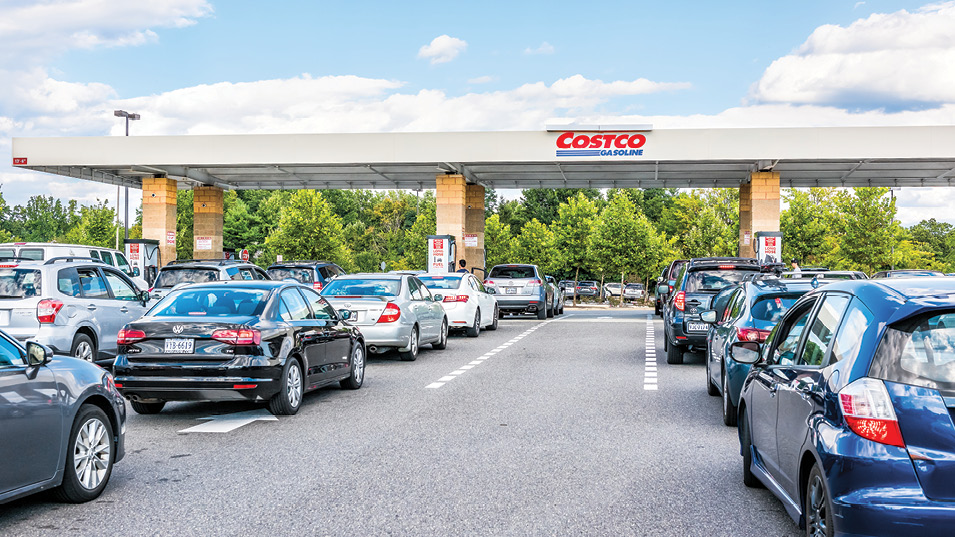
Neither attribute describes Costco, yet the company is having a record-breaking year selling fuel.
Two events from this February have played a big part in Costco’s surge in gasoline sales. In the beginning of that month, the company extended the hours of operation for its fuels centers from closing at 6:00 p.m. to closing at 9:00 or 10:00 p.m., depending upon location.
Then on February 28, hostilities began between the United States and Iran, which greatly affected the global petroleum distribution system and led to average U.S. gasoline prices spiking at $4.56 per gallon on May 21. Costco’s focus on low fuel prices led to a continued surge in fuels sales from price-conscious members. In a call discussing Costco’s third quarter results, which concluded in May, CEO Ron Vachris said the last five weeks of the quarter were the five highest-volume weeks for fuel sales in the company’s history.
NACS spoke to Mike Lopez, market research coordinator for EAI Inc. (also known as Energy Analysts International), an energy consulting and products firm, about what retailers can learn from Costco’s success. EAI Inc. tracks and analyzes the entire fuel chain, including sales across all retail segments.
By traditional definitions, Costco is not considered convenient for fueling. Obviously, price is a major consideration in driving traffic. But what else beyond that?
Mike Lopez: Costco’s business model is unique. Most, if not all, of its profits are generated by revenue from its loyalty card annual fees, and it has card renewal rates higher than 90%. Costco’s unique business model is to price its in-store products at prices yielding razor-thin margins.
But price is just one factor. Simplicity is another. The fueling stations have a simple, flexible layout of pumps that allows fueling from nearly any angle. There are also attendants who specialize in guiding motorists to open pumps to reduce wait times and maximize use.
Similar to its in-store offerings, Costco has decided to limit fuel options, rarely including diesel and never more specialized ethanol blends. EAI Inc. conducted a consumer study for the company to evaluate potential interest in diesel sales at stores. The response was “not much at all.” It’s a simplification that works for them and their primary customer base, which is not diesel intensive. The convenience industry is probably best served by offering more options, but there can be the idea of too much in some cases—like smaller, less busy sites where it may become a “more-is-less” overhead situation.
Other very large retailers have sold fuel—Walmart and The Home Depot come to mind, not to mention Sears in the 1970s—with varying degrees of success. What does Costco get right that they didn’t?
Lopez: Employees play a big role. Costco and others like QuikTrip seem to always have employees multitasking and able to flow to free up logjams in checkout lines and address other customer needs. Extra training to mold this kind of staffing is key. It also requires higher level benefits and upward mobility structures for staff retention.
Costco often touts its high employee satisfaction within the workplace. (Editor’s note: Both Costco and QuikTrip are featured in Zeynep Ton’s book, The Good Jobs Strategy. Professor Ton has been a featured speaker at multiple NACS events and the NACS Innovation Leadership Program at MIT.)
In June, Costco opened its first stand-alone gas station in Mission Viejo, California. What’s the broader concept behind a stand-alone store?
Lopez: It expands Costco’s marketing umbrella and increases membership sales—and it addresses the issue of overly busy on-site fuel sites. More fuel-only sites can help address demand and shorten lines for fuel at its other stores. While this isn’t a realistic model for the c-store industry, it underlines the importance of making your most popular items convenient and available.
Beyond fueling, what are lessons that c-stores can take away from Costco’s success?
Lopez: First, be famous for something. Beyond its overall business model, Costco is known for its prepared foods. Costco’s rotisserie chicken is almost a given to wind up in shoppers’ baskets, whether it’s on the shopping list or not. It’s hard to pass up given its quality and fixed price offering. Its $1.50 hot dogs have a similar allure.
In terms of layout, Costco leverages its size to guide the shopper through a couple hundred square feet of featured items—their treasure hunt area—before entering the vastness of the store. Convenience stores can adjust layouts for a smaller-scale adoption of this strategy.
Finally, I want to go back to simplicity. While convenience stores can’t operate on the same model where a membership locks in the low street price, the simpler the loyalty program, the better. Avoid overly complex loyalty programs that may dissuade customers and negatively impact less tech-savvy ones.
That simplicity also extends to products. One of Costco’s overall traits is that there are not tiers of brands or quality in the shopping experience. The same holds true at the pump.
.jpg?language=en-US)