Big Thunder Mountain Railroad, a popular roller coaster at Disneyland and Disney World, starts off with the warning to remove hats and glasses because “this here is the wildest ride in the wilderness.” Perhaps that recording should have been played to the entire transportation market at the beginning of 2026.
Yet, while there is significant uncertainty surrounding certain elements of the market, there are fundamentals that can help provide some indication of where the market might be heading in the next several years. It is upon these fundamentals that retailers should base their strategies.
A Wild 2026
A roller coaster launched on February 28 when hostilities began with Iran, resulting in the disruption to the Strait of Hormuz. That sent global oil markets into a sustained period of turmoil, punctuated by volatile announcements and headlines heralding the reopening of the Strait one day and then a return to violence the next.
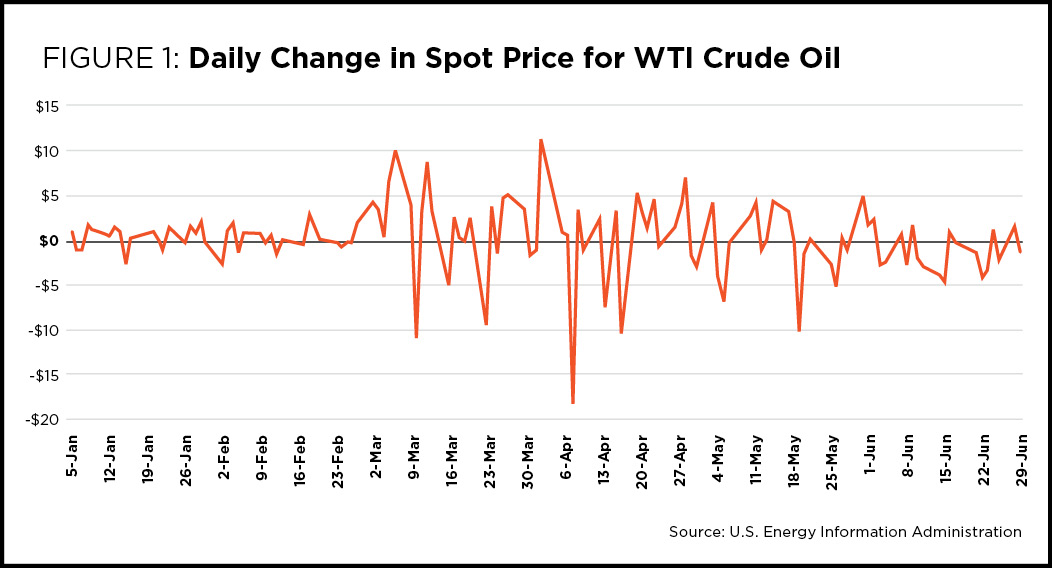
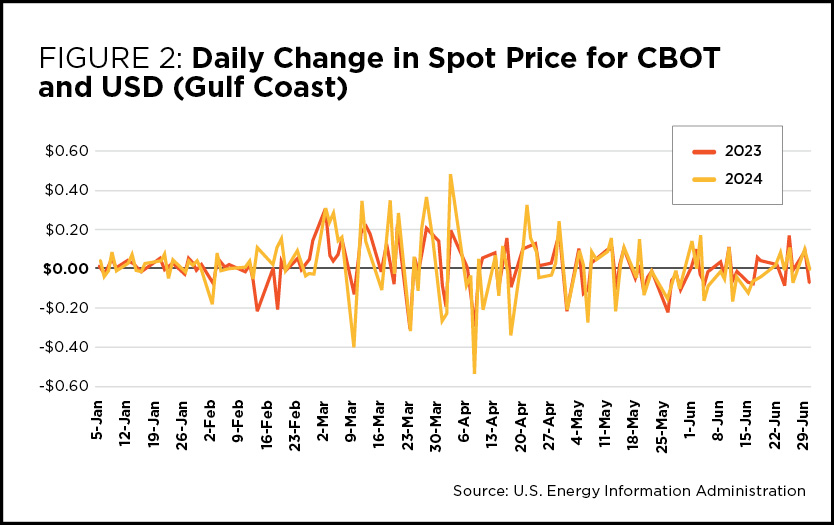
Take a look at the spot markets from the first six months of 2026. Figure 1 and Figure 2 show the volatility in the daily change in spot prices for oil and wholesale refined products.
What these charts don’t show are peaks and valleys within a single day. Retailers reported that they incurred swings in diesel wholesale costs of more than $1.00 in a single day.
Outlook for Demand
The volatility of the fuel market and higher retail prices have been pointed to as a causal factor in short-term demand destruction. Pundits like to claim that customers drive less when prices are high, but the data does not support that theory. And while some analysts have reported that same store sales have been down quite a bit, data for the market as a whole does not indicate that prices have driven consumption down.
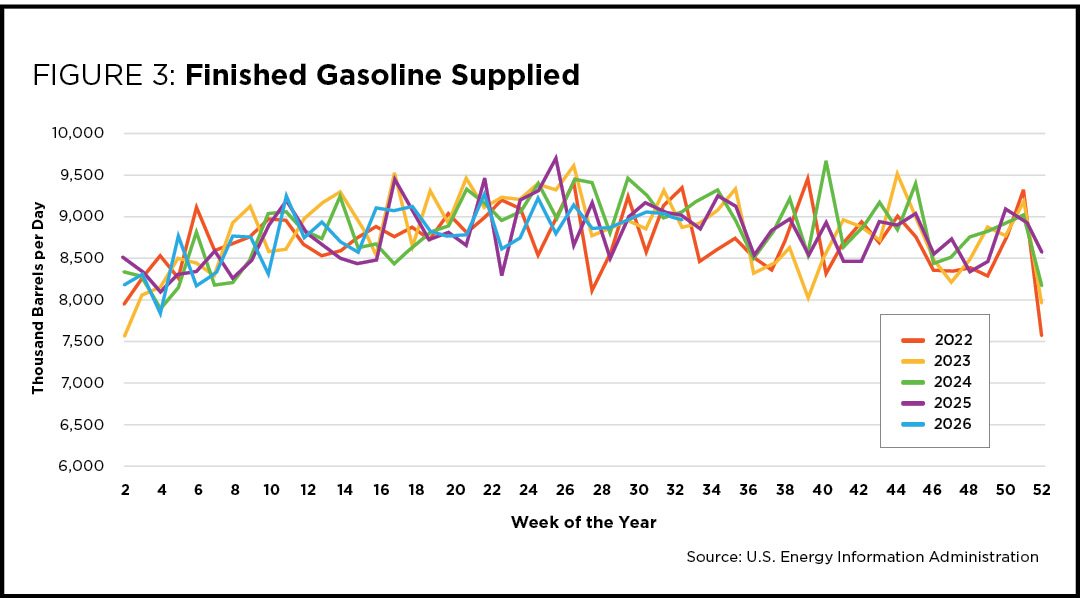
The U.S. Energy Information Administration (EIA) publishes data tracking the volume of finished gasoline delivered to the market every week as a proxy for consumption (see Figure 3). When looking at week-to-week comparisons over the past several years, there does not seem to be any significant short-term erosion in demand. Since 2022, the average barrels delivered each week during the first six months of the year have not really changed, with the delta between low and high only 1.6% over the time period. The data for 2026 does not indicate that prices have deterred consumers from driving— although prices have elevated the degree to which they complain.
While some dismiss EIA data as not reflecting what is happening at the retail pump, it at least provides an indicator of where the market is heading. Yes, demand is slipping. That’s not because of price sensitivity, but because the fuel efficiency of vehicles continues to improve.
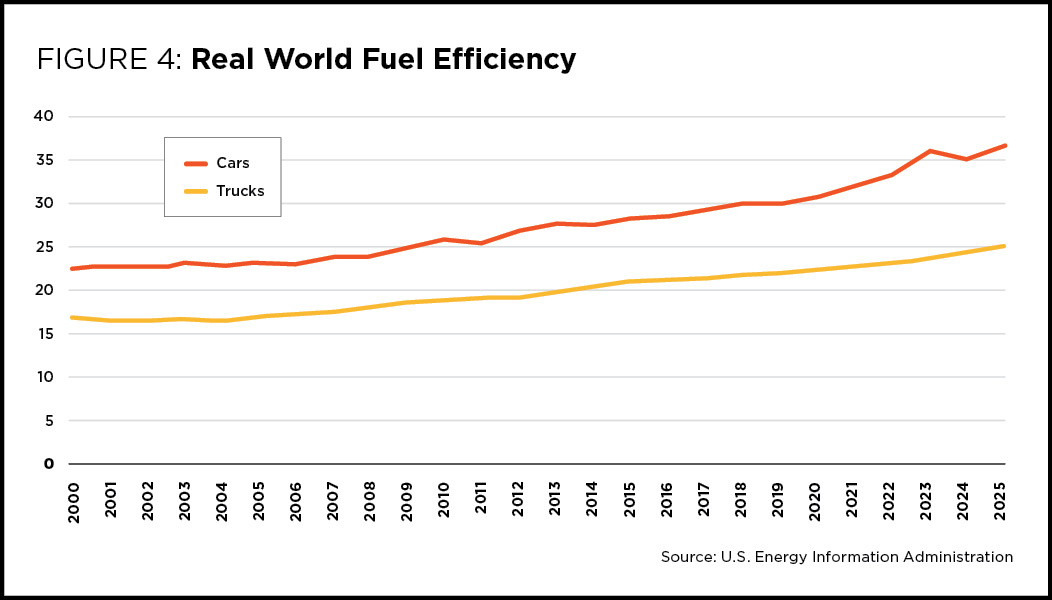
Real-world fuel efficiency of the vehicles in operation (not new vehicle sales) has improved 63% for cars and 49% for trucks since 2000. Even just since 2022, fuel efficiency is up from 33.3 to 36.6 mpg for cars and 23.0 to 25.0 for trucks (Figure 4).
Trajectory of the Vehicle Market
The primary factor driving the recent boost in fuel efficiency is improved internal combustion engine vehicles (ICEVs). While the growth in alternative powertrains, like hybrid electric vehicles (HEVs) and pure battery electric vehicles (BEVs), does contribute to a more efficient fleet, that impact is more directly felt when just looking at the new vehicles entering the market.
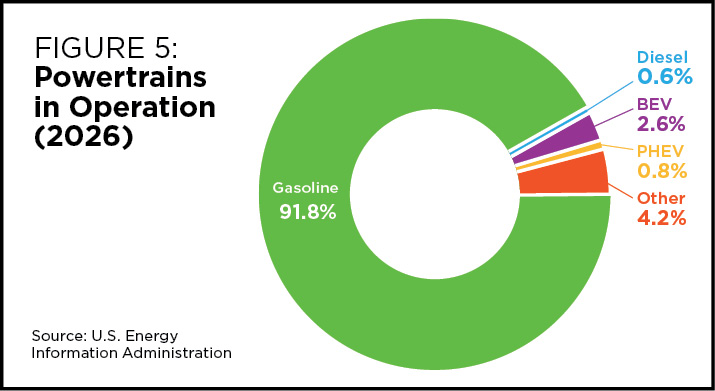
EIA reports that at the beginning of 2026 there were 273 million light duty vehicles in operation in the United States (Figure 5). Of these, 252 million (92.3%) were exclusively powered by gasoline or diesel fuel. From 2022 through June 2026, Americans purchased 4.8 million BEVs, 1.1 million plug-in hybrid electric vehicles (PHEVs) and 6.8 million HEVs. Together, these account for 18.3% of new vehicles sold. However, despite growth in these markets, they still account for less than 8% of vehicles in operation.
That said, the sales mix has evolved over the past few years. In 2022, ICEVs accounted for 87.8% of sales. Through the first half of 2026, that market share dropped to 77.8%. The bigger story is HEVs (5.6% in 2022 and 15.3% in 2026). The volume of HEV sales and the significantly higher fuel efficiency of most of those vehicles will have an impact on the fleet’s overall fuel efficiency in the coming years. Consequently, the 1.6% drop in gasoline supplied between 2022 and 2026 is likely to accelerate.
Although BEV sales have taken a hit recently due to the loss of the federal purchase incentive, manufacturers are retooling their strategies with a goal of delivering options that customers actually might want to buy. The market is poised to grow. The used vehicle market for BEVs is particularly worth watching.
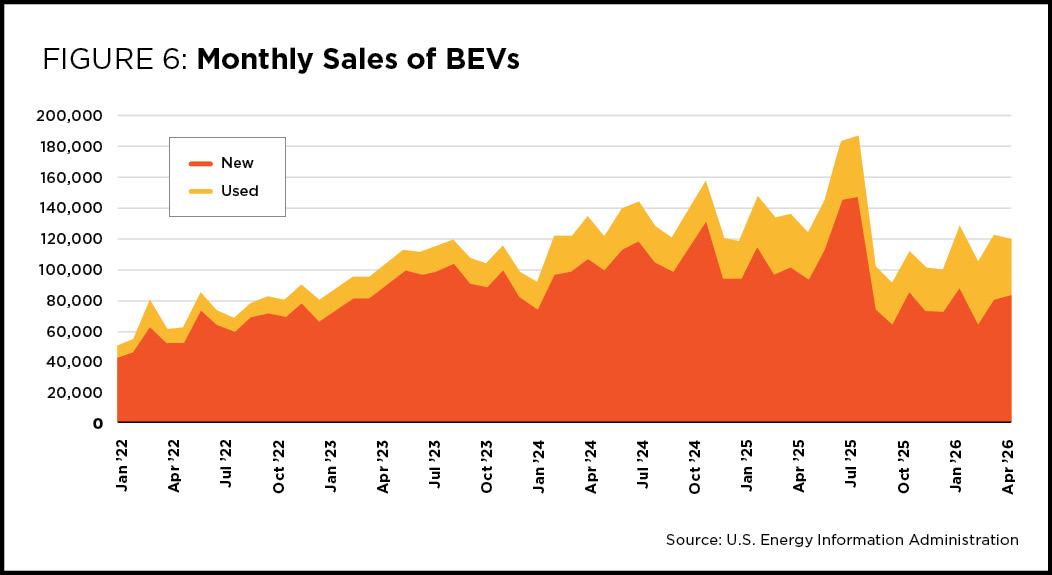
When BEVs entered the market, there were a lot of questions about their durability and viability in the used vehicle market. Now, with hundreds of thousands of these vehicles coming off of leases and entering used vehicle sales lots, the data indicates that the batteries are much more resilient than early testing suggested. Last year, Americans purchased around 360,000 used EVs from dealer lots, which are estimated to account for about 70% of used EV sales (data from private transactions are not available), and are on pace this year to purchase around 450,000 (Figure 6).
What this means for fuel retailers is that demand for public charging stations will continue to grow.
The price of buying a used EV is significantly lower than buying a new one, which means that many consumers who were previously priced out of the EV market now have the opportunity to participate. These consumers may represent a very different demographic profile than the original EV customer and may not have access to a place to charge their vehicles at home.
The number of fast chargers in the U.S. grew by 25% during the first half of 2026. One might expect this would negatively affect utilization, but that was not the case. According to the TEI Charging Analytics Program (CAP), utilization remained steady despite the expansion of locations and chargers. This means there remain opportunities for new public chargers in this market to be successful.
Outlook for Retail
The future for fuel and energy retailing remains bright. Traditional powertrains relying on liquid fuel will dominate the market for the next several decades, ensuring that the forecourt investments made by the industry will continue delivering customers and revenue. However, per capita fuel consumption is going down, so the focus should shift from selling gallons to generating trips.
At the same time, the market for EVs will continue to grow. Demand for public charging will grow with it, but so will the availability of chargers at non-fueling facilities. EVs introduce a new level of competition—no longer are convenience retailers battling only each other for the transportation customer, they are going up against restaurants, grocers, shopping centers and any other location with a parking lot. Differentiating the overall site offer will be essential to winning the EV customer, and it will enhance the draw to the fueling dispensers as well.
Convenience retail has been the dominant retail format for transportation energy for decades. There is no reason to believe this will not continue for decades to come, but the manner in which retailers go to market must evolve to enhance the value of the trip beyond acquisition of gallons.